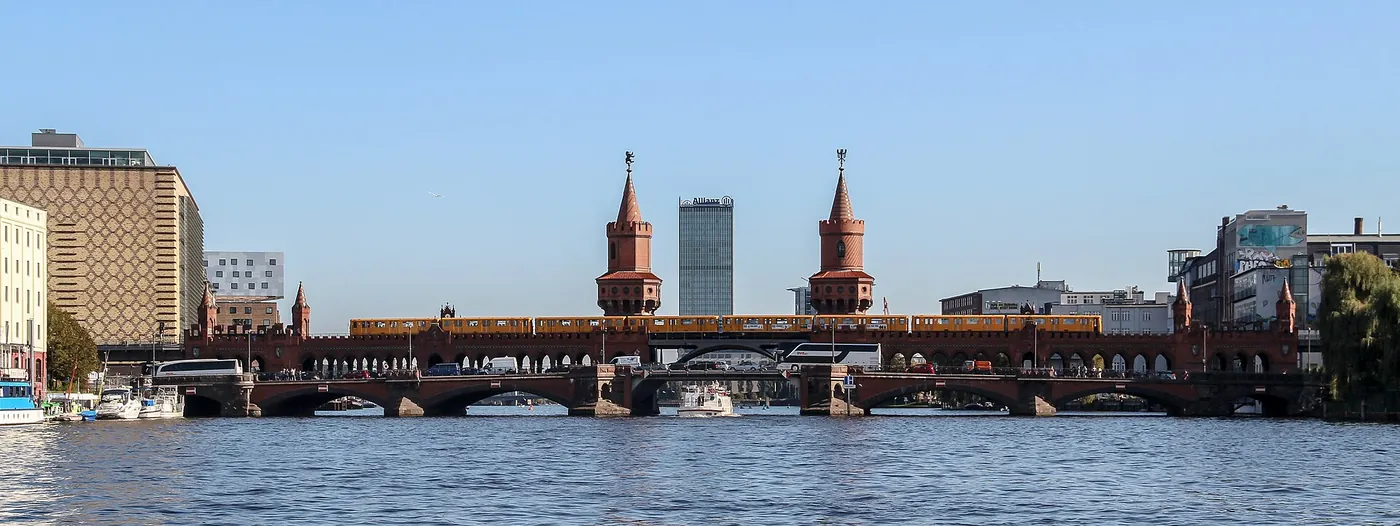
City · Berlin
BerlinInvesting in Berlin real estate: what an Israeli investor needs to know in 2026
Investing in Berlin real estate is investing in deep, stable demand in the capital of Germany. The average transaction price for an existing apartment in 2025 was about 4,751 euros per sq m, and rent in new contracts is much higher than that of long-term tenants. Someone who buys an apartment with a tenant in Berlin buys a stable income, and the potential of this gap over the years.
Video
Berlin in one minute
Investing in Berlin: the figures, what to check and common questions, in a short video. All details and sources are in the text below.
No narration, background music only. The video does not play by itself.
In brief
- 3,685,265 residents (IBB, 2024 data) and 206,458 students (Statistics Office Berlin-Brandenburg, winter 2025/26).
- Average transaction price for an existing apartment: 4,751 euros per sq m (2025). Transfer tax: 6% (as of November 2026).
- A striking gap: a rent index of 7.71 euros per sq m in existing contracts, versus 15.78 euros asking in new lettings.
- The rent brake applies to the whole city until 31.12.2029.
- Suited to an investor looking for value retention and a long holding period in a large, liquid market.
Why here
Why do investors look at Berlin real estate?
Berlin is the largest city in Germany, and most of its residents rent. The market is deep: there are buyers and sellers every quarter, so it is relatively easy to sell an apartment there compared with a small city. The capital attracts students, civil servants, tech companies and immigrants, and demand for rented apartments did not fall even in the years when interest rates rose.
The second reason is price. Compared with the other big cities, an existing apartment in Berlin is cheaper than in Munich and Hamburg. According to the "BIG 7" comparison by the Stuttgart valuation committee, the average in Berlin in 2025 was 4,751 euros per sq m, versus 8,150 in Munich and 5,761 in Hamburg. For a new apartment too, the entry price in Berlin is the lowest of the seven, 6,891 euros per sq m.
The third reason is the gap between existing rent and market rent. It exists throughout Germany, and in Berlin it is especially striking. For a long-term investor this is potential: the rent index rises from year to year, and every new letting moves closer to market prices.
In numbers
Key data: Berlin in numbers
- Population3,685,265IBB, Housing Market Report 2025 (2024 data)
- Average transaction price, existing apartment4,751 euros per sq mStuttgart valuation committee, BIG 7 comparison (2025)
- Average transaction price, new apartment6,891 euros per sq mSame (2025)
- Asking price per apartment5,807 euros per sq mIBB (2024 data)
- Rent in existing contracts (Mietspiegel)7.71 euros per sq m net cold (median)Rent index 2026, the Senate
- Asking rent in new lettings15.78 euros per sq mIBB (2024 data)
- Transfer tax6%Table of states, as of November 2026
- Students206,458AfS Berlin-Brandenburg, winter 2025/26 (provisional)
"Net cold" (Nettokaltmiete) is the rent without ongoing costs and heating. All the comparisons on the page refer to it.
The gap that defines the market: 7.71 vs 15.78 euros
The rent index (Mietspiegel) is a table of the usual rent in the city, and it is built from existing contracts. In 2026 the median in Berlin rose to 7.71 euros per sq m, compared with 7.21 euros in 2024 (Berlin Senate, 2026). Apartments advertised for rent were offered at 15.78 euros per sq m on average. That is, a new tenant pays about twice what a long-term tenant pays.
For an investor this means two things. An apartment bought with a long-term tenant gives a stable income: in a rough calculation of rent by the index against the average transaction price, the gross yield is about 1.9% a year, and the rent rises together with the index. If the apartment becomes vacant and is re-let on market terms, the theoretical gross yield is close to 4%. The German rental law protects long-term tenants, so a long-term tenant usually stays for many years, and that is exactly what makes the income predictable.
Re-letting also has rules. The rent brake in Berlin applies to the whole area of the city, and the Senate extended it until 31.12.2029. In a new contract you may ask up to 10% above the usual local rent, under the German rental law, rent brake, with exceptions for new construction and comprehensive renovation. It is also worth knowing the rules for raising rent for an existing tenant before building a forecast.
Want to check whether this suits you?
Book an intro callEconomy and employment: who rents in Berlin?
Berlin's economy is based on services. The public sector, the universities and the Charité hospital are large employers. Deutsche Bahn and Siemens have headquarters and broad operations in the city, and Siemens is developing Siemensstadt Square as a new work and residential district. Alongside these, the city has one of the largest startup scenes in Europe. In nearby Brandenburg, in Grünheide, a Tesla plant operates, which also draws workers to the eastern neighborhoods.
Demand for apartments in Berlin rests on internal and external migration, on more than 200 thousand students and on a continuing shortage of construction. The tenant pool is broad and varied: students, civil servants, tech workers and families. What to do in case of late payment, and how the management company handles it, is explained in the guide on a tenant who does not pay.
Where in the city
Which neighborhoods in Berlin do you buy in?
Berlin is divided into 12 districts (Bezirke), and the gaps between them are large. The following list is a qualitative description and not a ranking.
| Neighborhood | Character | Who it suits |
|---|---|---|
| Mitte, Prenzlauer Berg | Central, renovated Altbau, high prices | Value retention and liquidity |
| Charlottenburg-Wilmersdorf | Classic west, an established population | Stable long-term tenants |
| Friedrichshain-Kreuzberg | Young, high demand, many conservation areas | Someone planning a long holding period with no changes to the apartment |
| Neukölln (the north) | Fast renewal, a broad population mix | An investor who checks street by street |
| Lichtenberg, Treptow-Köpenick | East, lower prices, new construction | A somewhat higher yield, proximity to jobs in the east |
| Spandau, Marzahn-Hellersdorf | The outskirts, prefabricated construction (Plattenbau) | Low entry price, proximity to transport lines |
In social conservation areas (Milieuschutz), luxury renovation, merging apartments or converting to owner-occupied apartments require approval from the district. Berlin also has a regulation that restricts splitting a rented building into separate apartments, and the Senate extended it until the end of 2030. For a detailed overview by neighborhood, see investment apartments in Berlin.
What you buy
Which property types are common in Berlin?
Most of the supply for private investors is single apartments in buildings with an owners' committee. Three types are common:
- Altbau: A building from before 1949, mostly from the early 20th century. High ceilings and a central location. You check the plumbing, roof and facade, and the committee's renovation plan. The differences are explained in the Altbau vs Neubau comparison.
- Prefabricated construction from the East German period: A low entry price. You check the insulation and the committee's costs.
- Neubau: New construction, more expensive per sq m, with a partial exception from the rent brake in a first letting and higher depreciation.
Whole buildings in Berlin are mostly sold to institutional investors, so most private investors buy single apartments.
Illustrative example
How much does it cost to buy an apartment in Berlin? A numerical example
To the yield calculatorAssumptions: an existing apartment of 60 sq m at the average transaction price for 2025, without a broker. The conversion to shekels is by an assumption of 4 shekels per euro, for illustration only.
| Component | Amount |
|---|---|
| Price (60 × 4,751) | 285,060 euros (about 1.14 million shekels) |
| Transfer tax 6% | 17,104 euros |
| Notary and registration (market estimate of 1.5%–2%) | 4,276–5,701 euros |
| Total before financing | about 306,400–307,900 euros |
| Annual rent by the rent index (7.71 × 60 × 12) | 5,551 euros |
| Annual rent by asking price (15.78 × 60 × 12) | 11,362 euros |
The difference between the last two rows is Berlin's potential: the same apartment can bring in twice as much in a new letting. So it matters to check the existing contract, the tenant's tenure and the rent against the index. All the costs that come with a purchase are detailed in the guide to closing costs, and the financing options for a non-resident are in mortgages in Germany for foreigners.
Before you decide
Advantages and what to check in Berlin
Advantages
- A relatively deep and liquid market, with local and international buyers
- Rental demand based on a large population, students and migration
- A lower price per sq m than Munich, Hamburg and Frankfurt (2025)
- Legal stability: registration in the land register (Grundbuch) and a notary in every deal
- A gap between existing rent and market rent, with potential over time
What to check
- The existing rental contract: level, tenure and payment history
- The rent against the city's rent index
- Whether the building is in a conservation area, before a renovation plan
- The owners' committee minutes and the renovation plan
- The total cost, including the 6% transfer tax
Before you buy
What do you check before buying in Berlin?
- Calculate the yield by the existing contract. In a rented apartment the contract decides, and the rent rises according to the rental rules.
- Check whether the building is in a conservation area (Milieuschutz). A renovation plan is coordinated with the district in advance.
- Buy a single apartment and not a building to split. Splitting a rented building into apartments is restricted in most of the city until 2030.
- Read the owners' committee minutes. In an old building you check in advance for decisions on a roof or facade renovation.
Available properties in Berlin
All the available properties are gathered in open investment properties.
Frequently asked questions
What people ask us About Berlin
Is it worth investing in Berlin real estate in 2026?
It depends on the goal. Berlin suits especially someone looking for value retention in a deep, liquid market, who plans a long holding period. The gap between the existing rent and the market rent gives the apartment potential over the years.
How much does an apartment cost in Berlin?
The average of transactions for an existing apartment in 2025 was 4,751 euros per sq m, and for a new apartment 6,891 euros (BIG 7 comparison, 2025). Asking prices are higher than that, 5,807 euros per sq m according to IBB. In practice the gaps between neighborhoods are larger than the gap between Berlin and other cities.
Does the rent brake apply to all of Berlin?
Yes. The Senate extended the rent brake ordinance to the whole area of the city, in force from 1.1.2026 until 31.12.2029. In a new contract the rent is limited to 10% above the usual local rent, with exceptions for new construction and comprehensive renovation.
Berlin or Leipzig?
Berlin is larger and more liquid, and Leipzig offers a lower entry price and a growing city. The full comparison, with price per sq m and rent in each city, is in Berlin or Leipzig for investment. Someone considering another A city can also see real estate in Hamburg.
What is the transfer tax in Berlin?
6% of the property price, as of November 2026. It is paid once, after signing at the notary. On a 300,000 euro apartment that is 18,000 euros.
Sources
- IBB: Berlin Housing Market Report 2025, summary: population, asking price and asking rent (2024 data)
- German Federal Ministry of Justice: rental law, termination of a contract by the landlord (in force 2026)
- German Federal Ministry of Justice: rental law, the rent brake (in force 2026)
- Berlin Senate: rent index 2026, median 7.71 euros per sq m (May 2026)
- Statistics Office Berlin-Brandenburg: students (winter 2025/26)
- Stuttgart valuation committee, BIG 7 comparison: average transaction prices for apartments (2025, published March 2026)
- berlin.de: Senate announcement on extending the rent brake until 2029 (2025)
This is not investment, tax or legal advice. Every investment carries risk.

Intro call
Want to look at Berlin with your own numbers?
We will go through a neighborhood, a property type and a real yield calculation with you, including the gap between existing rent and market rent.
In the photo: Munich and the Alps, Bavaria