City · Baden-Württemberg
StuttgartInvesting in Stuttgart Real Estate: A Wealthy A-City at a B-City Entry Price
Investing in Stuttgart real estate is a special case among Germany's A-cities: an existing apartment sold in 2025 for an average of about 4,250 euros per sqm, a relatively low entry price compared with the seven biggest cities, while a new apartment cost almost double. The city is wealthy, with high employment, the headquarters of global industrial companies and an especially active apartment market. Whoever buys in Stuttgart buys a strong city with a limited supply of apartments.
Video
Stuttgart in one minute
Investing in Stuttgart: the figures, what to check and common questions, in a short video. All details and sources are in the text below.
No narration, background music only. The video does not play by itself.
In brief
- 606,682 residents in June 2025 (city statistics office), plus hundreds of thousands more in the metropolitan area.
- Existing apartment: about 4,250 euros per sqm. New apartment: 8,055 euros per sqm (Stuttgart valuation committee, 2025).
- The city's rent index (Mietspiegel) 2025/2026: 11.15 euros per sqm on average.
- Transfer tax of 5% (Baden-Württemberg, as of November 2026).
- An especially active market: 7.3 housing transactions per 1,000 residents in 2025, the leading pace among the BIG 7 cities.
Why here
Why do investors look at Stuttgart?
Stuttgart is the capital of Baden-Württemberg, one of Germany's wealthiest states. Unemployment in the state stood at 4.6% in October 2026, well below the 6.3% national average (BA, October 2026). The tenants here are mostly engineers, industrial workers and well-paid professionals.
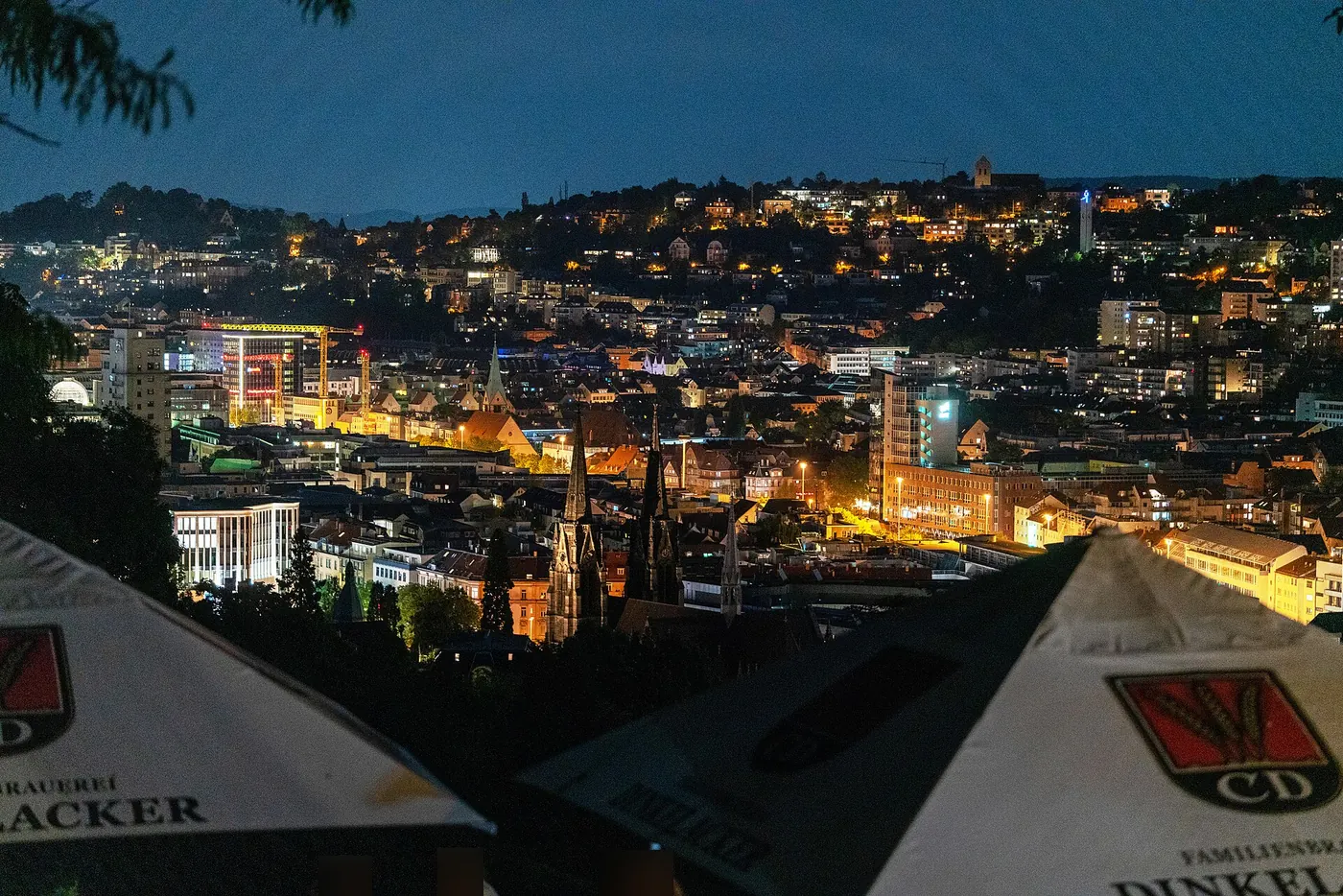
Supply is physically limited. The city sits in a narrow valley (Kessellage), surrounded by hills and forests, with little room to expand. That is why new construction is very expensive, and the gap between an existing and a new apartment is especially large: 8,055 versus about 4,250 euros per sqm. For an investor, this means that an existing apartment in a good district is an accessible entry point to an A-city, in a market where it is hard to add new apartments.
The market is also liquid. In 2025, 3,112 existing apartments were sold in the city, about 10% more than in 2024, and Stuttgart led the seven biggest cities in transactions per capita (Stuttgart valuation committee). Anyone who wants to sell in the future will find an active market.
In numbers
Key figures: Stuttgart in numbers
- Population (register)606,682City statistics office, 30.6.2025
- Average transaction price, existing apartmentabout 4,250 euros per sqmStuttgart valuation committee (2025)
- Average transaction price, new apartment8,055 euros per sqmSame (2025)
- Existing apartments sold3,112 (about 10%+ vs. 2024)Same (2025)
- Average rent, Mietspiegel 2025/202611.15 euros per sqm net of heatingCity of Stuttgart (reference date April 2024)
- Asking rent in a new letting[verify: no current official figure]
- Transfer tax5%State table, as of November 2026
- Unemployment, agency district5.7%, below the national averageStuttgart employment agency, 2025 average
- Students, University of Stuttgart20,415Baden-Württemberg statistics office (2025 report)
Alongside the university, the city is home to the Baden-Württemberg Cooperative State University (DHBW), the Stuttgart Media University (HdM), the University of Applied Sciences (HFT) and academies of art and music, so student demand is broader than the number in the table.
The car industry and technology: Stuttgart's economic engine
Mercedes-Benz has its headquarters and its plant in Untertürkheim in Stuttgart. Porsche is based in Zuffenhausen, and Bosch, the world's largest automotive supplier, is run from nearby Gerlingen. Hundreds of suppliers operate around them, among them Mahle. This is what made Stuttgart one of Germany's wealthiest cities.
The industry is now investing in electric vehicles, automotive software and autonomous driving, and research and engineering fields are growing around it. The universities, research institutes and development centers of the big companies attract engineers and tech people to the city, and many of them rent apartments close to work.
Want to check whether it suits you?
Book an intro callWhat do these figures mean for an apartment owner?
Three things. The first: according to the valuation committee, existing apartment prices in 2025 stayed steady, while the number of transactions rose by about 10%. This is a market with active demand and value retention. The second: housing demand spreads across the whole Stuttgart region, including the suburbs and nearby districts, which are connected to the city by rail. The third: supply cannot grow much, because of the topography and construction costs, so an existing apartment in a good location stays in demand.
In a rough calculation, a Mietspiegel of 11.15 euros against a price of 4,250 euros gives a gross yield of about 3.1% a year, higher than Munich and Hamburg. In Stuttgart the yield comes together with stability and long-term value retention.
Where in the city
Stuttgart districts: where it is expensive and where it suits renting
| District | Character | Note for the investor |
|---|---|---|
| Stuttgart-Mitte, West | Center, Altbau, dense | Very high demand, close to all services |
| Stuttgart-Nord (Killesberg), Degerloch | Hills, villas and views | Luxury and value retention |
| Stuttgart-Süd, Ost | Urban residential, varied | A balance between price and demand |
| Bad Cannstatt | The big district, mixed | More accessible entry, choose the street carefully |
| Feuerbach, Zuffenhausen | North, near Porsche and Bosch | Demand from industrial and engineering workers |
| Untertürkheim, Obertürkheim | Near the Mercedes-Benz plant | Demand from plant workers and suppliers |
| Vaihingen, Möhringen | South, university campus and offices | Demand from students and office workers |
In Stuttgart it is worth checking not only the district but also the nearby employers. An apartment near the campus in Vaihingen or in the city center enjoys demand from several different groups: students, office workers and industrial workers. In the hillside districts the topography also matters: slopes, stairs and parking affect demand more than in flat cities.
What you buy
Which types of property are common in Stuttgart?
Most of the supply is apartments in post-war buildings, because a large part of the city was destroyed in the bombings. Altbau remains mainly in the west, the south and parts of Bad Cannstatt. In buildings from the 1950s to the 1970s you check the heating system and insulation, following the energy certificate guide. New apartments are very expensive, and whole buildings are rarely sold in the city.
Illustrative example
A worked example: a 60 sqm apartment in Stuttgart
To the yield calculatorAssumptions: the average transaction price for an existing apartment (2025), no agent, rent per the Mietspiegel. Conversion at 4 shekels per euro, for illustration only.
| Component | Amount |
|---|---|
| Price (60 × 4,250) | 255,000 euros (about 1.02 million shekels) |
| Transfer tax 5% | 12,750 euros |
| Notary and registration (market estimate of 1.5%–2%) | 3,825–5,100 euros |
| Total before financing | about 271,600–272,900 euros |
| Annual rent per the Mietspiegel (11.15 × 60 × 12) | 8,028 euros |
The transfer tax here is about 3,800 euros lower than for an apartment of similar size and price in Düsseldorf, where the tax is 6.5%. All the additional costs are detailed in the closing costs guide.
Rental rules in Stuttgart
Stuttgart is covered by the Baden-Württemberg rent brake ordinance. According to the state government, the ordinance has been extended at least until the end of 2026, and drafts have been submitted to extend the related rules until the end of 2029. In a new lease, up to 10% above the locally customary rent is usually allowed, that is, above the city's Mietspiegel values. A market with clear rules is also a more predictable market for a landlord.
Stuttgart from the point of view of an investor from Israel
Stuttgart has an advantage that is easy to miss: it is an A-city with a B-city entry price. With the equity that buys one apartment in Munich you can buy almost two here, and with a lower transfer tax than in northern Germany. For those looking to diversify outside Israel, it is a way into one of the wealthiest regions in Europe.
Another consideration is the holding horizon. Stuttgart is investing in automotive software, energy, research and engineering, and the city benefits from each of these fields. An investor with a horizon of 10 years or more, who chooses a district by its sources of employment, builds a property with varied demand.
Before you decide
Advantages and what to check in Stuttgart
Advantages
- An accessible entry price for an existing apartment in an A-city (2025)
- An active, liquid market, with transactions up by about 10%
- A wealthy state with unemployment below the national average
- Transfer tax of 5%, lower than NRW and Berlin
- Limited supply because of the valley and hills
What to check
- The district and the employers close to it
- The rent in the existing lease versus the Mietspiegel
- The heating system, insulation and energy certificate
- Topography, stairs and parking in the hillside districts
- The owners' association minutes and the maintenance plan
Who is Stuttgart real estate especially suited for?
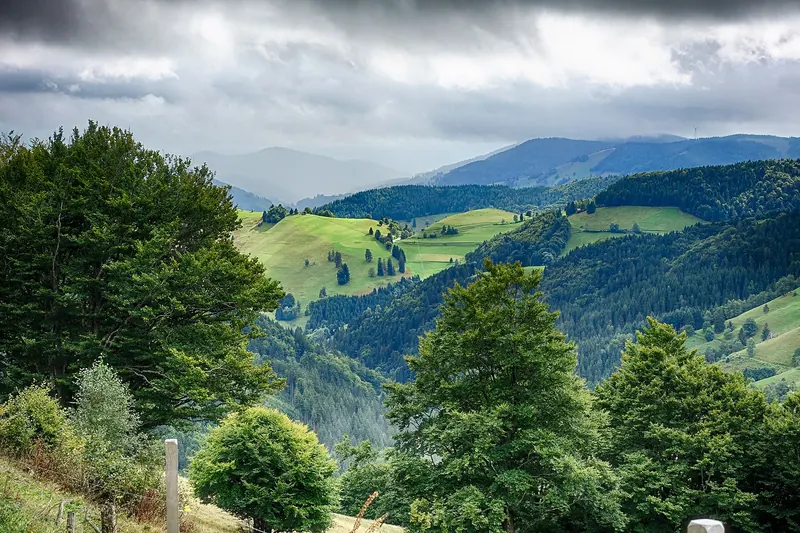
Stuttgart suits those looking for a wealthy A-city at an accessible entry price, with an active market and well-paid tenants. Those who prefer an even broader economy and long-term value retention can compare with Munich. Those looking for a holiday property in the same state will find a completely different model in the Black Forest. The differences between big and small cities are explained in big city vs. small town and in the guide to A, B and C cities, and the link between the economy and housing prices in Germany's economy and real estate. You plan the exit already at the purchase, following the exit strategy guide.
Open properties in Stuttgart
A comparison of all the cities is on the Germany real estate map.
Frequently asked questions
What people ask us About Stuttgart
How much does an apartment in Stuttgart cost?
According to the city's valuation committee, an existing apartment sold in 2025 for an average of about 4,250 euros per sqm, and a new apartment for 8,055 euros. An existing 60 sqm apartment therefore costs about 255,000 euros on average.
Are prices in Stuttgart stable?
Yes. According to the valuation committee, the price of an existing apartment in 2025 was similar to 2024, and the number of transactions rose by about 10%. The limited supply and demand from the whole metropolitan area support value retention.
What is the transfer tax in Stuttgart?
5% of the property price, the Baden-Württemberg rate (as of November 2026). On an apartment of 255,000 euros that is 12,750 euros.
What is the rent in Stuttgart?
The Mietspiegel 2025/2026 shows an average rent of 11.15 euros per sqm net of heating in the surveyed leases. In a new lease, up to 10% above the locally customary rent is usually allowed, under the rent brake.
Stuttgart or Munich?
Stuttgart is much more accessible for an existing apartment, with a transfer tax of 5% versus 3.5% in Munich, and a higher gross yield. Munich is bigger and more economically diverse, and especially suited to value retention. The choice depends on budget and goal.
Sources
- City of Stuttgart: city statistics office, population data for the first half (August 2025)
- City of Stuttgart: valuation committee, real estate market 2025 (February 2026)
- City of Stuttgart: Mietspiegel 2025/2026, average rent 11.15 euros per sqm (December 2024)
- Federal Employment Agency: labor market in Baden-Württemberg (October 2026)
- Stuttgart employment agency: district data (2025 average)
- Stuttgart valuation committee, BIG 7 comparison: price and transaction pace comparison (2025)
- Baden-Württemberg statistics office: student report (2025)
This is not investment, tax or legal advice. Every investment involves risk.

Intro call
Want to check whether Stuttgart suits you?
We will walk you through a district, the sources of employment around it and a yield calculation, and compare with other cities.
In the photo: Munich and the Alps, Bavaria