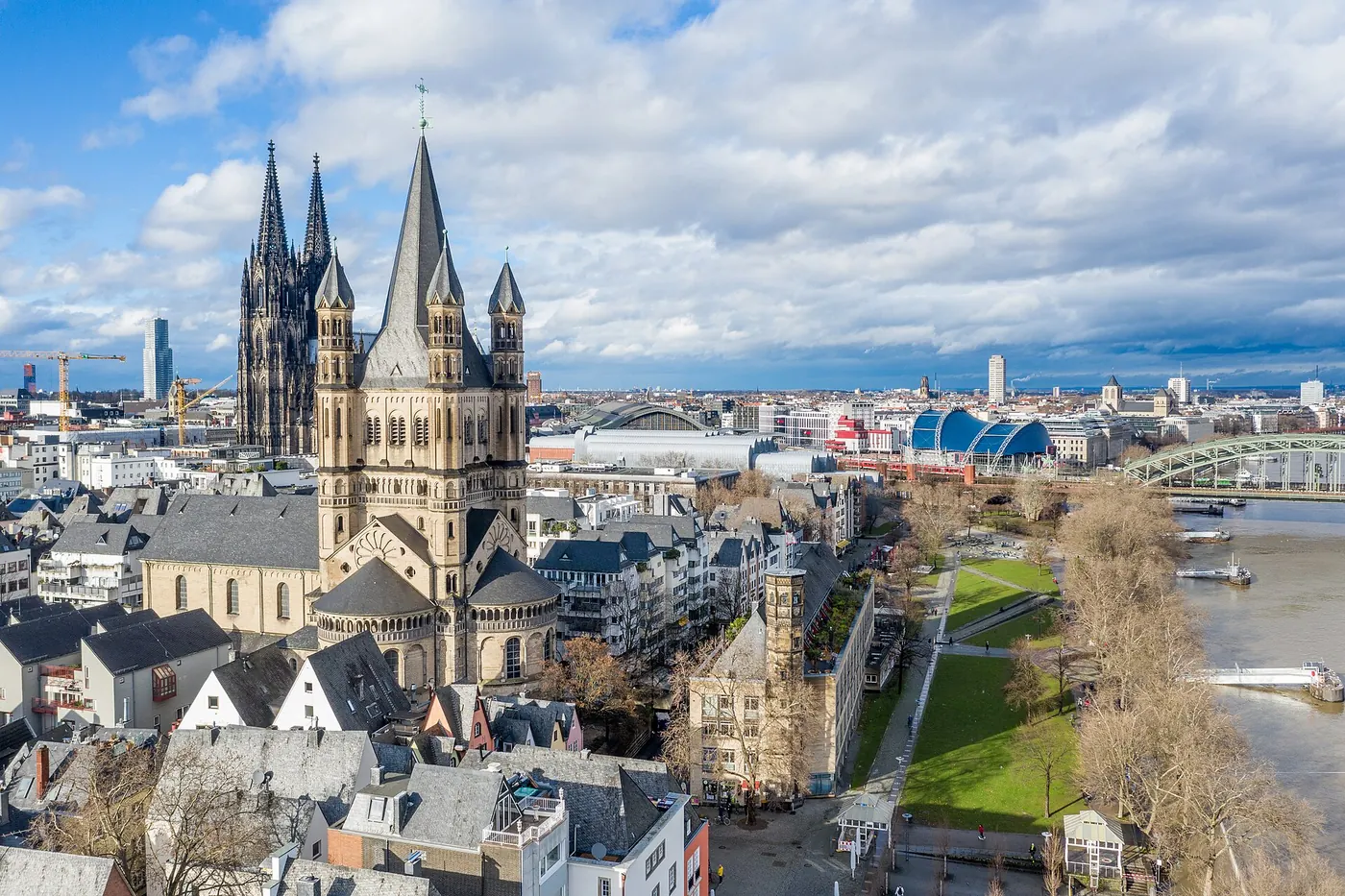
City · North Rhine-Westphalia
CologneInvesting in Cologne Real Estate: the Big City of NRW, in Numbers
Investing in Cologne real estate offers a good ratio between price and rent compared with other major German cities. In 2025 an existing apartment sold for an average of 4,407 EUR per sq m, and the median asking rent was 14.70 EUR per sq m, after a 4.8% rise in one year. Transfer tax in NRW is 6.5%, so it enters the calculation on the day of purchase.
Video
Cologne in one minute
Investing in Cologne: the figures, what to check and common questions, in a short video. All details and sources are in the text below.
No narration, background music only. The video does not play by itself.
In brief
- 1,100,076 residents according to the city register (31.12.2025). According to the official NRW statistics: 1,024,621 (31.12.2024).
- Existing apartment: 4,407 EUR per sq m. New apartment: 7,065 EUR per sq m (2025 transaction average).
- Asking rent (median): 14.70 EUR per sq m in 2025, up 4.8% in one year (City of Cologne).
- Transfer tax 6.5% (NRW, as of November 2026).
- 92,656 students in winter 2025/26, one of the largest concentrations in Germany.
Why here
Why do investors look at Cologne real estate?
Cologne is the largest city in North Rhine-Westphalia, the most populous state in Germany, and the fourth largest city in the country. It is a regional employment center: in 2024 it had 633,306 employees covered by social insurance, and the commuter balance was positive by more than 179 thousand people (IT.NRW). In other words, many more people commute into Cologne to work than out of it, and some of them want to live close by.
The ratio between price and rent stands out. As a rough calculation, an asking rent of 14.70 EUR against a transaction price of 4,407 EUR gives a gross yield of about 4.0% per year on a new letting. That is almost double Hamburg by the city average, and more than Munich. The calculation does not include expenses, and it fits an apartment let on market terms, not one with a long-standing tenant.
A shortage of apartments strengthens demand. In 2024, 1,788 apartments were completed in Cologne, fewer than the ten-year average (2,687), and 9,433 approved apartments were in the pipeline but not yet built (NRW.BANK, 2025). The average household size is 1.8 people, so demand for small apartments is high.
In numbers
Key figures: Cologne in numbers
- Population, city register1,100,076City of Cologne, 31.12.2025
- Population, official statistics1,024,621IT.NRW (2022 census base), 31.12.2024
- Average transaction price, existing apartment4,407 EUR per sq mStuttgart Valuation Committee, BIG 7 comparison (2025)
- Average transaction price, new apartment7,065 EUR per sq mSame (2025)
- Asking rent (median)14.70 EUR per sq mCity of Cologne, rental housing supply 2025
- Asking rent on re-letting14.00 EUR per sq mNRW.BANK, housing market profile (2024 data)
- Transfer tax6.5%State table, as of November 2026
- Employees by place of work633,306IT.NRW, 2024
- Students92,656Cologne statistical yearbook, winter 2025/26
Why are there two population figures?
The city's residents' register counts those who are registered, while the state's official statistics are updated from the 2022 census base, so the two figures differ. When one website writes "1.1 million" and another "1.02 million", both are quoting an official source.
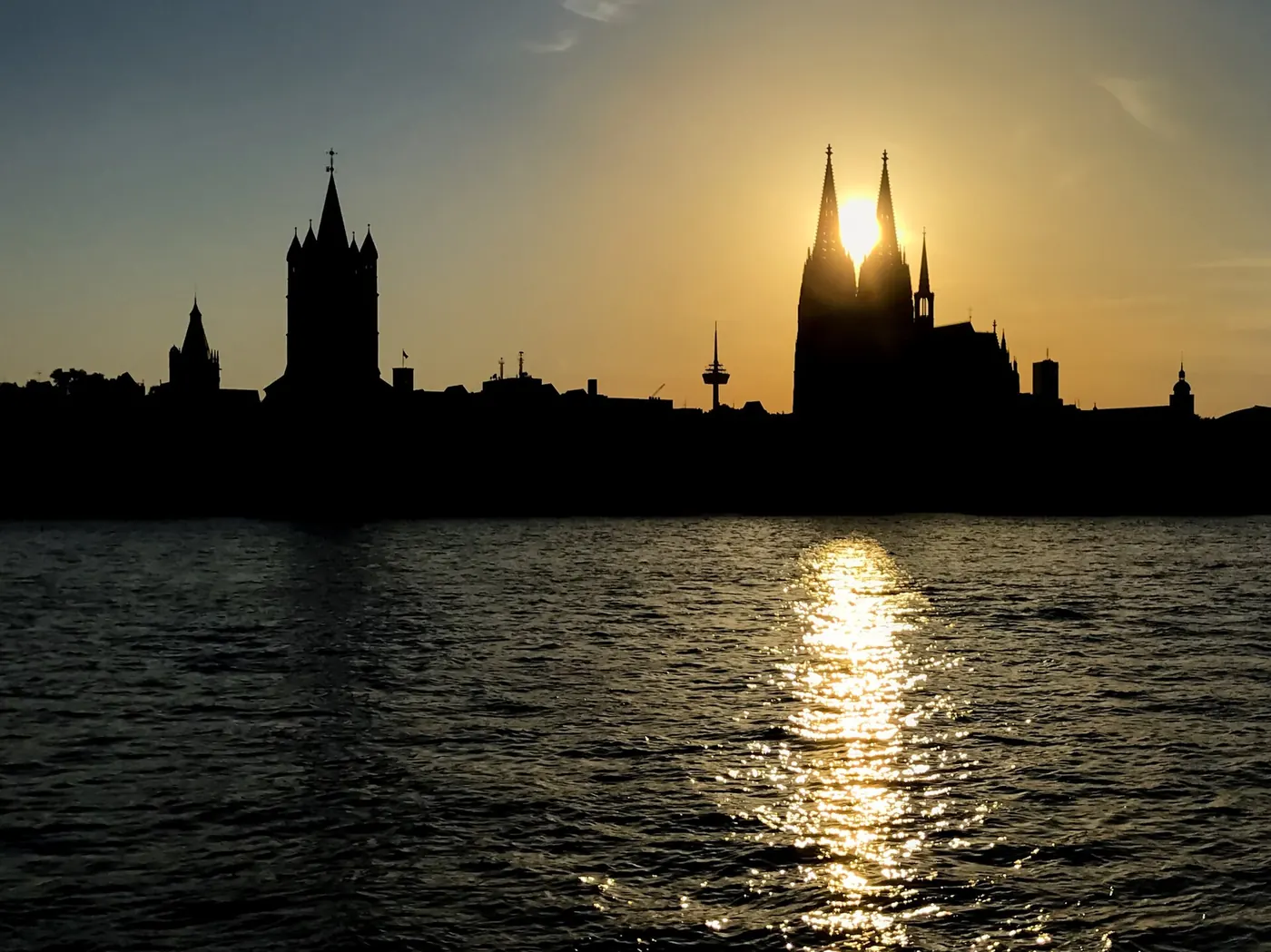
Economy and employment: media, insurance and industry
Cologne is the media capital of Germany. The public broadcaster WDR and RTL Deutschland are based there, together with many production companies. Ford Germany has a headquarters and a plant in the city, REWE Group is run from Cologne, and so are Lanxess and TÜV Rheinland. Lufthansa is registered in Cologne, and the Koelnmesse exhibition center brings international events.
This variety is Cologne's advantage: media, trade, insurance, industry, universities and trade fairs. Each of these sectors brings the city workers who rent apartments, from young people at the start of their careers to families and executives. Before buying, check the lease and the tenant's payment history, and not only the level of the rent.
Want to check whether it suits you?
Book an intro callStudents: strong demand for small apartments
In winter 2025/26, 92,656 students studied in Cologne, of whom 45,502 at the University of Cologne (Cologne statistical yearbook). This is one of the largest concentrations in Germany, and it creates steady demand for one- and two-room apartments. A small apartment near the campus in Lindenthal or Sülz lets easily, and in these districts it makes sense to calculate on the demand of both students and young professionals.
Where in the city
Cologne districts: where it is pricey and where it suits letting
| District | Character | Note for the investor |
|---|---|---|
| Lindenthal, Sülz, Klettenberg | Near the university, Altbau, families and students | Very high demand, high price |
| Belgisches Viertel, Südstadt | Urban center, lively | Good liquidity, small apartments in demand |
| Ehrenfeld, Nippes | Up-and-coming, young districts | Balance between price and demand |
| Deutz, Mülheim | Right bank, new projects | Growth and renewal, check street by street |
| Kalk, Porz | Down-to-earth, lower price | Higher yield, check street by street |
| Chorweiler | High-rise housing from the 1970s | Entry at a low price, check the condition of the building and the owners' association |
| Rodenkirchen, Marienburg | Luxury by the Rhine | Value retention and long-term stability |
The rough division in Cologne is between the left bank of the Rhine, which has most of the sought-after districts and the university, and the right bank, where prices are lower and renewal is faster. An investor looking for a balance between price and demand usually finds the opportunities in the transition districts, such as Ehrenfeld, Nippes and Deutz.
Cologne also has preservation areas (Erhaltungssatzung) in some inner districts, where luxury renovation and conversions require approval.
What you buy
What types of property are common in Cologne?
Most of the supply is apartments in buildings constructed after World War II, because the city center was rebuilt after it. Altbau from the beginning of the century exists mainly in districts such as Südstadt, Ehrenfeld and Nippes. In buildings from the 1950s and 1960s it is worth checking insulation, windows and the heating system in particular. One- and two-room apartments are especially in demand because of the small households.
Illustrative example
A numerical example: a 60 sq m apartment in Cologne
To the yield calculatorAssumptions: average transaction price for an existing apartment (2025), no broker, the apartment is re-let at the asking median. Conversion at 4 NIS per euro, for illustration only.
| Item | Amount |
|---|---|
| Price (60 × 4,407) | 264,420 EUR (about 1.06 million NIS) |
| Transfer tax 6.5% | 17,187 EUR |
| Notary and registration (market estimate of 1.5%–2%) | 3,966–5,288 EUR |
| Total before financing | about 285,600–286,900 EUR |
| Annual rent at the asking median (14.70 × 60 × 12) | 10,584 EUR |
| Gross yield on the apartment price | about 4.0% |
Transfer tax is usually paid from equity, so plan for it in advance. All the additional costs are detailed in the closing costs guide, and financing for a non-resident is explained in mortgages in Germany for foreigners.
Rental regulation in Cologne
On 1.3.2025 NRW expanded the tenant protection ordinance (Mieterschutzverordnung) from 18 to 57 municipalities, and Cologne is included. The expansion reflects the high demand for housing in the city. In practice: in a new lease the rent is limited to up to 10% above the local customary rent, and existing tenants have a reduced limit on increases. The calculation of possible increases is explained in the rent increase guide.
Long-term letting: the stable model in Cologne
The Koelnmesse fairs and the carnival attract visitors, and investors from Israel sometimes ask about tourist letting. Cologne has a municipal ordinance protecting residential housing (Wohnraumschutzsatzung), and short-term letting of a whole apartment throughout the year usually requires approval from the city. For this reason the calculations on this page are based on regular long-term letting, with a permanent tenant and predictable income.
What should an investor from Israel consider in Cologne?
Three things. The first is transfer tax: 6.5% paid from equity and usually not financed, so it is worth calculating the required equity on the total cost. The second is ongoing taxation: rental income in Germany is taxable in Germany even for a non-resident, and it also has implications in Israel. How the two countries divide the tax is explained in the guide to the Israel-Germany tax treaty. The third is management: in a large city like Cologne there is a wide supply of management companies, which makes holding from a distance easier.
Before you decide
Advantages and what to check in Cologne
Advantages
- Good price-to-rent ratio for major cities: about 4% gross on a new letting
- Regional employment center with a large positive commuter balance
- Apartment shortage and small households that strengthen demand
- Active market: 6.4 housing transactions per 1,000 residents (2025)
- About 92 thousand students and demand for small apartments
What to check
- The total cost, including 6.5% transfer tax
- The district and the street: proven rental demand
- The existing lease and the payment history
- The condition of the building: insulation, windows and heating
- The Rhine flood map and building insurance
Who is Cologne real estate especially suited to?
Cologne suits an investor who wants a large, liquid city, with broad rental demand and a good ratio between price and rent. Those who prefer lower transfer tax can look at Bavaria, where the tax is 3.5%. Those looking for a lower entry price in the same region can look at Duisburg. And those who prefer a business city with high salaries can compare with real estate in Düsseldorf, 40 kilometers away.
Open properties in Cologne
All available opportunities are on open properties for investment.
Frequently asked questions
What people ask us About Cologne
How much does an apartment in Cologne cost?
The 2025 transaction average for an existing apartment was 4,407 EUR per sq m, and for a new apartment 7,065 EUR (BIG 7 comparison). A 60 sq m apartment therefore costs about 265,000 EUR on average, before transfer tax and costs.
What is the rent in Cologne?
The median asking rent for apartments offered for letting in 2025 was 14.70 EUR per sq m, compared with 14.00 in 2024 (City of Cologne). Long-standing tenants usually pay less, according to the city's rent index (Mietspiegel).
How much transfer tax is paid in Cologne?
6.5% of the property price, the North Rhine-Westphalia rate since 2015 (as of November 2026). On an apartment of 265,000 EUR that comes to 17,225 EUR.
Does Cologne have a rent brake?
Yes. Cologne is included in the NRW tenant protection ordinance, which was expanded on 1.3.2025 to 57 municipalities. In a new lease, up to 10% above the local customary rent is usually allowed.
Cologne or Düsseldorf?
Cologne is larger, with more students and a slightly better ratio between price and rent. Düsseldorf is smaller, with a high concentration of jobs and high salaries. Transfer tax is the same, 6.5%, because both are in NRW.
Sources
- City of Cologne: statistics, registered population (31.12.2025)
- IT.NRW: Cologne municipal profile, population, employment and commuting (2024)
- City of Cologne: rental housing supply 2025, median 14.70 EUR per sq m (2026)
- NRW.BANK: Cologne housing market profile 2025, construction and rents (February 2026)
- City of Cologne: statistical yearbook 2025, chapter 6, students (winter 2025/26)
- Cologne Employment Agency: labor market data (2025)
- Stuttgart Valuation Committee, BIG 7 comparison: transaction prices and transaction pace (2025)
This is not investment, tax or legal advice. All investment involves risk.

Intro call
Want to test Cologne with a real calculation?
We will go through a district, a lease and the costs with you, including NRW transfer tax.
In the photo: Munich and the Alps, Bavaria