City · North Rhine-Westphalia
DuisburgInvesting in Duisburg Real Estate: An Accessible Entry Price in a Growing Port City
Investing in Duisburg real estate attracts investors because of the entry price: in 2024 a resale apartment in the city cost an average of about 1,837 EUR per sq m, about two thirds of the average for the state of NRW, and the rent on re-letting stood at about 7.71 EUR per sq m (NRW.BANK, 2024). Duisburg is a city of about half a million residents, with one of the largest inland ports in the world, a large university and a population that has grown over the last decade. The ratio between price and rent gives a gross yield higher than in the large cities of southern Germany.
Video
Duisburg in one minute
Investing in Duisburg: the figures, what to check and common questions, in a short video. All details and sources are in the text below.
No narration, background music only. The video does not play by itself.
In brief
- 502,270 residents (IT.NRW, 31.12.2024), compared with 485,465 in 2014.
- Resale apartment: about 1,837 €/sq m on average in 2024, compared with about 2,762 on average in NRW (NRW.BANK).
- Rent on re-letting: about 7.71 €/sq m, and in new construction about 11.92 (NRW.BANK, 2024).
- Transfer tax 6.5% in NRW (as of November 2026).
- There is no rent brake in the city (Deutscher Mieterbund, as of November 2026).
Why here
Why do investors look at Duisburg real estate?
The first reason is the ratio between price and rent. When an apartment costs less than 2,000 €/sq m and the rent is close to 8 €/sq m, the gross yield reaches about 5%, more than can be achieved in the large cities of southern Germany. The page on investing in real estate in NRW presents the comparison between the cities of the state.
The second reason is growth. Contrary to the image of the Ruhr, Duisburg's population grew over the last decade by about 17 thousand residents, mainly thanks to migration (IT.NRW, 2014–2024). More residents mean a broader base of tenants.
The third reason is flexibility. Duisburg is not on the list of NRW municipalities where the rent brake applies, so in a new lease the landlord sets the rent according to the market, subject to the general rules of tenancy law.
In numbers
Key figures: Duisburg in numbers
- Population502,270IT.NRW, municipal profile, 31.12.2024
- Growth over the decadeabout 17 thousand residents (from 485,465 in 2014)IT.NRW
- Resale apartment priceabout 1,837 €/sq m (NRW: about 2,762)NRW.BANK, housing market profile 2025 (2024 data, empirica)
- Rent, re-lettingabout 7.71 €/sq m (NRW: about 9.41)NRW.BANK, 2024
- Rent, new constructionabout 11.92 €/sq mNRW.BANK, 2024
- Transfer tax6.5%NRW, since 2015, as of November 2026
- StudentsIT.NRW / the university
The data from NRW.BANK, the bank of the state of NRW, is based on listings (the empirica database), and not on signed transactions, so actual transaction prices can differ from the asking ones. The comparison with the state average is consistent: in Duisburg you buy for about a third less, and let for about a fifth less. That is the ratio that produces the yield.
Economy and employment: port, steel and what lies between
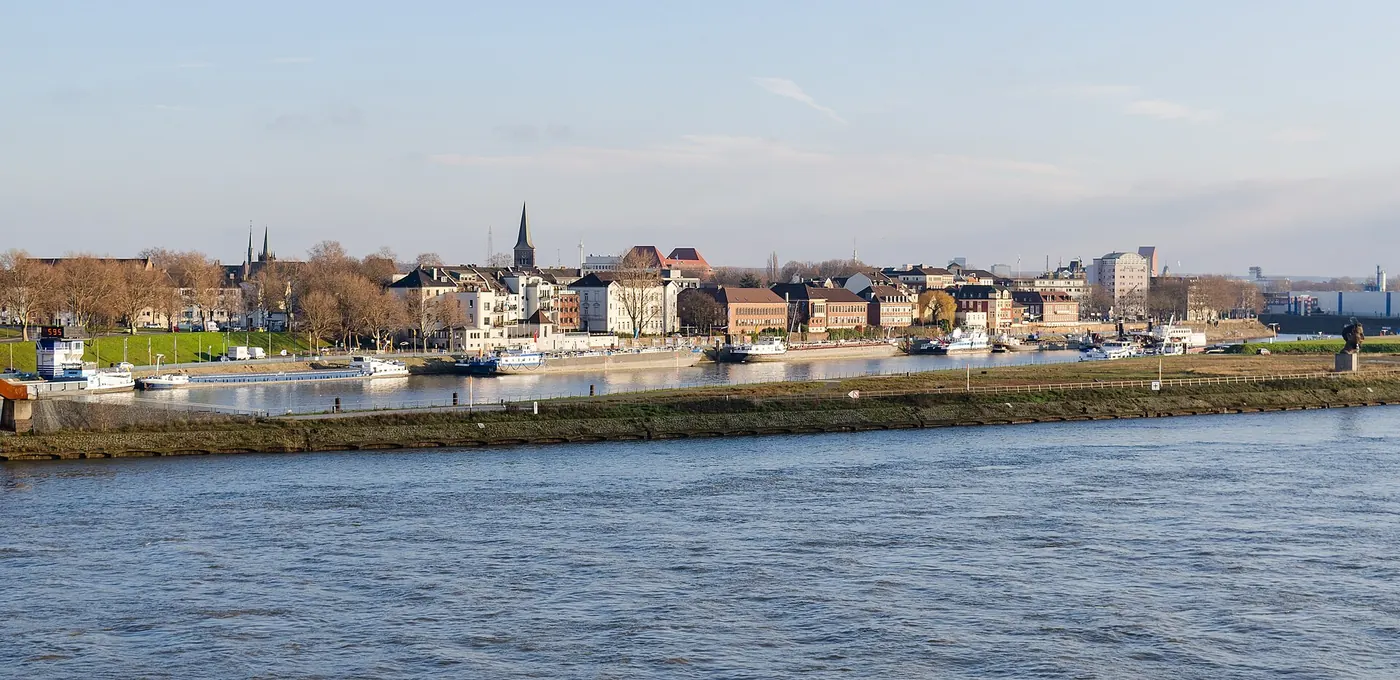
Duisburg is built on two pillars. The first is the port: the Port of Duisburg (duisport), at the meeting of the Rhine and the Ruhr, is one of the largest inland ports in the world and a logistics hub for freight trains from East Asia. Logistics employs thousands and attracts warehouses and distribution centers.
The second pillar is steel. thyssenkrupp Steel operates its largest production site in Duisburg, and is advancing there a move to green steel production, without coal [verify: project status and timetable against thyssenkrupp announcements]. This is an established industry that is investing in its future in the city.
Alongside these, the city is home to the University of Duisburg-Essen, hospitals and the chemical industry. Another advantage is the location: Düsseldorf, the capital of NRW, is about a quarter of an hour away by train, and some residents work there and live in Duisburg. The comparison on the page real estate in Düsseldorf shows how large the price gap is between two cities so close to each other.
Want to check whether it suits you?
Book an intro callWhere in the city
Duisburg districts: the differences here are very large
In Duisburg the district matters more than the city. Choosing the right street is a central part of the deal:
- Neudorf and Duissern: east of the center, near the university. Altbau buildings, students and young families. Among the stable districts in the city.
- Dellviertel and the center: close to the station and the shopping center. Reasonable demand, and each building is checked on its own merits.
- Huckingen, Buchholz and Wedau: south of the city, near the Sechs-Seen-Platte lakes. Green and quiet, many private houses, and tenants who stay for years.
- Ruhrort: the historic port district. A special character, limited supply and steady demand.
- Rheinhausen: west of the Rhine, with a history of the steel industry. Accessible entry prices and varied demand.
What you buy
Which properties do you buy in Duisburg?
An apartment in a building from the 1950s to the 1970s. This is most of the stock in the city. An accessible entry price, and you check heating, roof, insulation and the energy certificate. Energy requirements in Germany are rising, so it is worth planning the energy renovation in advance. The energy certificate guide explains what the numbers mean.
A property for renovation. The gap between an apartment in poor condition and a renovated one is large, so some investors buy, renovate and re-let. This requires a reliable contractor, supervision and an orderly budget. The guide a renovation property in Germany goes through the costs and the process.
A whole building. In Duisburg you can buy a small building for the sum with which Munich buys an apartment. The advantage is spreading the income across several apartments. The comparison with a similar city with building stock, Herne, shows how close the two markets are.
Before you decide
Advantages and what to check in Duisburg
Advantages
- Accessible entry price, about 1,837 €/sq m
- Gross yield of about 5% according to listings
- A population that grew over the last decade
- No rent brake
- Port, logistics and a university as employers
What to check
- The district and the street: proximity to the university, transport and the center
- The existing leases and the payment history
- The condition of the building: roof, heating, insulation and energy certificate
- A budget for energy renovation, based on a quote and not an estimate
- 6.5% transfer tax in the entry cost calculation
Who is Duisburg real estate especially suited to?
Duisburg suits an investor looking for a relatively high gross yield and an accessible entry price, who is willing to choose the street and the building carefully. It suits those planning a holding of 10 years or more, with a cushion for maintenance and renovation, and those who work with a local team. Those weighing different types of markets can read big city or small town: A, B and C cities and the guide on common mistakes in investing in Germany.
Common mistakes in Duisburg
The first mistake is to buy on gross yield alone, without calculating expenses, maintenance and months between tenants. The second mistake is to buy an apartment in a building where the owners' association has difficulty approving renovations, so read the minutes before buying. The third mistake is not to plan the energy renovation, which will come at some point.
What does it mean when the tenant receives support from the Jobcenter?
Some tenants in Duisburg receive their rent through the Jobcenter, as part of "housing costs" (Kosten der Unterkunft). The city sets a ceiling for a "reasonable" rent according to household size, and the Jobcenter pays up to that ceiling [verify: current ceilings in Duisburg]. The advantage: regular payment, sometimes directly to the landlord. When calculating a deal in Duisburg, check the ceiling before assuming a rent.
How do you exit a property in Duisburg?
Plan the exit already at purchase. In Duisburg the main buyers are other investors, so the sale price is set by the yield the property produces. An apartment let on a proper contract in a well-maintained building is the easiest property to sell. A sale more than ten years after purchase is exempt from capital gains tax in Germany. The options are detailed in the guide exit strategy and the guide on capital gains tax in Germany.
Illustrative example
A calculation example: an apartment in Duisburg
To the yield calculatorAn example for illustration only. A 65 sq m apartment at 1,837 €/sq m, that is about 119,400 EUR. Transfer tax 6.5% (about 7,760 EUR), notary and registration usually about 1.5%–2% by market estimates (about 1,800–2,400 EUR). Without a broker, the entry is about 129 thousand EUR.
At 7.71 €/sq m, annual income before expenses is about 6,010 EUR, a gross yield of about 4.7%. Now a conservative assumption: one vacant month a year and 1,000 EUR of maintenance beyond the owners' association fees. Income falls to about 4,500 EUR, and the yield to about 3.5% before tax. The full calculation is in the net yield guide, and the costs are detailed in the guide closing costs for buying a property.
Open properties in Duisburg
Frequently asked questions
What people ask us About Duisburg
Is it worth investing in Duisburg real estate?
Duisburg suits an investor looking for a relatively high gross yield and an accessible entry price, in a city that is growing and relies on a port, logistics and a university. Choosing the street and the building is the important part of the deal, so each property is checked on its own merits.
How much does an apartment in Duisburg cost?
According to NRW.BANK, a resale apartment was offered in 2024 at an average of about 1,837 €/sq m, compared with about 2,762 on average in NRW. These are asking prices in listings, and the actual transaction price can differ from them.
What is the rent in Duisburg?
According to the same source, the rent on re-letting was about 7.71 €/sq m in 2024, and in new construction about 11.92 €/sq m. Duisburg has no rent brake, and increases in an existing contract are made under the rules of German tenancy law.
Is the population of Duisburg growing?
Yes. According to IT.NRW, the population rose from 485,465 in 2014 to 502,270 in 2024, mainly thanks to migration. As in any large city, the decision on a property is made at the district and street level.
What is the transfer tax in Duisburg?
Duisburg is in NRW, and transfer tax there is 6.5% (as of November 2026), compared with 3.5% in Bavaria. On a property of 120 thousand EUR the difference is about 3,600 EUR.
Sources
- IT.NRW, Duisburg municipal profile (2024 data)
- NRW.BANK, Duisburg housing market profile 2025 (February 2026, 2024 data)
- duisport, Port of Duisburg (2026)
- University of Duisburg-Essen (2026)
- Deutscher Mieterbund, list of municipalities with a rent brake (2026)
- German Ministry of Justice: tenancy law, rent increases (in force 2026)
This is not investment, tax or legal advice. All investment involves risk.

Intro call
Let's check Duisburg together
In Duisburg the check matters more than the price. We will go through the street, the building and the conservative scenario with you before you decide.
In the photo: Munich and the Alps, Bavaria