Region · Federal state
NRWInvesting in NRW Real Estate: Germany's Largest Housing Market, from the Rhine to the Ruhr
Investing in NRW (North Rhine-Westphalia) real estate means entering Germany's largest housing market: 17,986,214 residents at the end of 2025, more than in any other state (IT.NRW, 06/2026). NRW offers two kinds of market. The Rhine cities, Cologne and Düsseldorf, have strong demand and values that hold over time. The Ruhr cities, such as Duisburg and Herne, have an accessible entry price and a higher gross yield. The transfer tax across the whole state is 6.5%.
Video
NRW in one minute
Investing in NRW: the figures, what to check and common questions, in a short video. All details and sources are in the text below.
No narration, background music only. The video does not play by itself.
In brief
- NRW (Nordrhein-Westfalen) is Germany's most populous state, with almost 18 million residents and a dense network of cities.
- Transfer tax has been 6.5% since 2015, as in Brandenburg, Saarland and Schleswig-Holstein.
- The average asking rent for re-lets rose from 9.41 euros per sqm in 2024 to 9.84 in the first half of 2025 (NRW.BANK).
- Cologne: 14.70 euros per sqm asking rent (median, 2025), up 4.8% in a year.
- The choice in NRW is between stability and value retention in the Rhineland, and an accessible entry price with a higher gross yield in the Ruhr.
Why here
Why is NRW interesting for an investor from abroad?
NRW is Germany's historic industrial heart. About 18 million people live in an area roughly half the size of Bavaria, in dozens of cities linked by rail and motorways. That density creates steady demand for rental apartments.
According to NRW.BANK, the state's development bank, the market has warmed up again: in the first half of 2025, apartments for rent were let within 19 days on average, and apartments for sale sold after 67 days, 19 days faster than a year earlier. The bank attributes this to returning demand and more stable interest rates (NRW.BANK, 02/2026).
In numbers
Key figures: NRW in numbers
- Population17,986,214IT.NRW, 31.12.2025
- Transfer tax6.5%In force since 01.01.2015
- Asking rent, re-lets9.41 euros per sqmNRW.BANK, 2024
- Asking rent, H19.84 euros per sqmNRW.BANK, 2025
- Time to let19 daysSame, H1 2025
- Time to sell an apartment67 daysSame
How much is transfer tax in NRW?
Transfer tax in NRW is 6.5% of the property price, as of November 2026. The base rate in the federal transfer tax act (Grunderwerbsteuer) is 3.5%, but each state may set its own rate, and NRW raised it to 6.5% in 2015 [verify with the NRW finance ministry before purchase].
A worked example. Assumption: a property at 200,000 euros.
| NRW (6.5%) | Bavaria (3.5%) | Berlin (6%) | |
|---|---|---|---|
| Transfer tax | 13,000 euros | 7,000 euros | 12,000 euros |
| Difference vs. NRW | 6,000 euros less | 1,000 euros less |
In NRW, transfer tax is 6.5% of the price, and on top of it come the notary, registration and sometimes the agent. Together, the additional costs can reach 10% or more, depending on the agent's commission [verify: breakdown per deal]. Each component is explained in the closing costs guide. That is why in NRW people plan a long holding period, in which the entry costs are spread over many years of income. Anyone looking for a lower transfer tax can compare with real estate in Bavaria.
Want to check whether it suits you?
Book an intro callCity map: where in NRW?
Rhineland: Cologne and Düsseldorf
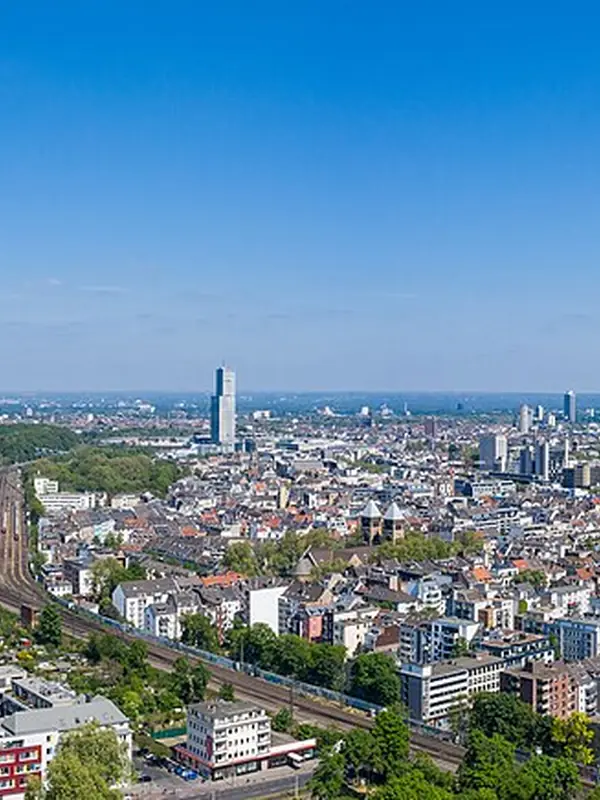
Cologne is the largest city in NRW, with 1,025,523 residents according to IT.NRW at the end of 2025. The city itself counts 1,100,076, based on its own residents' register. The difference comes from the counting method: IT.NRW relies on the 2022 census, and the city on the local register. The asking rent in Cologne was 14.70 euros per sqm (median) in 2025, up 4.8% from the previous year (City of Cologne, 2026). A large university, media and insurance industries, and strong demand.
Düsseldorf, the state capital, had 619,444 residents at the end of 2025. A city of offices, finance and fashion, with some of the highest prices in NRW [verify: price per sqm].
The Ruhr: Duisburg, Herne and more
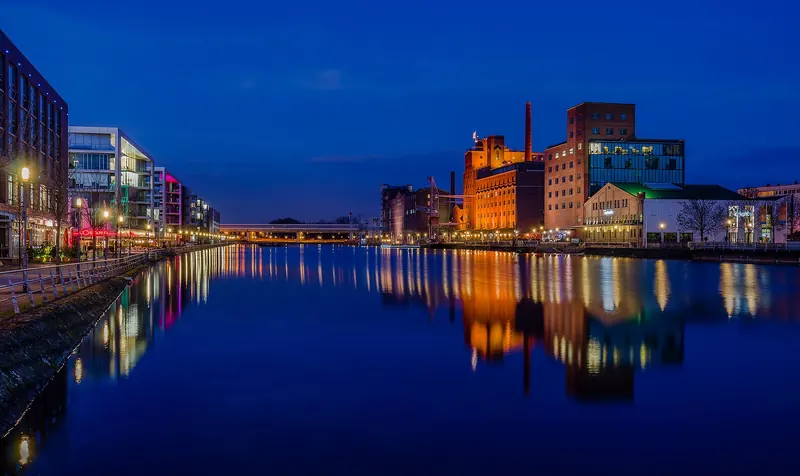
Duisburg, with 502,270 residents at the end of 2024 (versus 485,465 in 2014, IT.NRW), is the largest inland port city in Europe. The population has grown over the past decade, mainly thanks to migration. An accessible entry price, logistics and a university, and a choice that is made at street level.
Herne had 155,851 residents at the end of 2024 (IT.NRW), and sits in the heart of the Ruhr, between Bochum, Gelsenkirchen and Dortmund. Whole buildings at accessible prices are common here, with yield and a spread across several tenants.
Other cities in the Ruhr: Dortmund (600,880 residents) and Essen (573,618), both large cities with universities and more diverse employment (IT.NRW, 31.12.2025).
Comparison table: NRW cities
| City | Population | Asking rent | Profile | Advantage for the investor |
|---|---|---|---|---|
| Cologne | 1,025,523 (2025) | 14.70 euros per sqm (2025) | University, media, insurance | Strong demand and value retention |
| Düsseldorf | 619,444 (2025) | [verify] | Capital, finance, offices | High-income tenants |
| Dortmund | 600,880 (2025) | [verify] | University, logistics | Large city at a mid-range price |
| Essen | 573,618 (2025) | [verify] | Energy, services | Diverse economy |
| Duisburg | 502,270 (2024) | [verify] | Port, industry | Accessible entry price and a growing population |
| Herne | 155,851 (2024) | [verify] | Whole buildings, central location in the Ruhr | Gross yield and a spread across tenants |
The last column is our own qualitative assessment, not an official ranking. The average for all of NRW, 9.84 euros per sqm, gives an idea: the Rhine cities are above it, and many of the Ruhr cities are below it.
Economy and employment: what does demand in NRW rest on?
In the past fifty years NRW's economy went through Germany's biggest transition: from coal and steel to services, logistics, energy, insurance and media. Today the Rhine cities are centers of finance, insurance and media, and the Ruhr has built an economy of logistics, healthcare, energy and large universities, such as Ruhr University Bochum and the University of Duisburg-Essen.
For an investor, the question is not "how is the NRW economy doing" but who your tenant is and where they work. A student in Cologne, a logistics worker in Duisburg and a retiree in Herne are three different kinds of demand, each with its own advantage. NRW.BANK also notes that in about a quarter of the state's households live only people aged 65 and over, and that only about 3% of apartments are fully accessible (NRW.BANK, 02/2026). In other words, there is large demand for accessible apartments, with a lift and close to services, and it is expected to grow in the coming decades.
Financing and tax in NRW
The tax rules are the same across Germany: rental income is subject to income tax in Germany even for an Israeli resident, and a sale after more than 10 years of ownership is exempt from capital gains tax in Germany. Transfer tax in NRW is not deducted as a current expense, but is added to the property's cost and recovered through depreciation over the years [verify with a tax advisor]. The details are in real estate taxation in Germany.
Banks assess each city and neighborhood on its own, and the equity requirement is set by the property and its location. For what banks check with an Israeli investor, see mortgages in Germany for Israelis.
Growing areas in NRW
The federal institute BBSR classifies every municipality by its growth trend, using six indicators: population, migration, working-age population, jobs, unemployment and the business tax base (BBSR, 2019–2024). In NRW, the Rhine axis, Cologne, Bonn and Düsseldorf, tends toward the growing side [verify: classification of each city on the BBSR map]. This is an official, free tool that is worth checking before any city.
Even within one city, the neighborhood matters. In the Ruhr, the choice between two addresses in the same city can affect the deal more than the choice between two cities. A general comparison of Germany's markets is on the page East vs. West Germany.
What you buy
What kinds of property do people buy in NRW?
- An apartment in Cologne or Düsseldorf: an active market, many tenants and value retention over time.
- A residential building in the Ruhr: for the price of one apartment in Cologne you can sometimes buy a small building in Herne or Gelsenkirchen. You check the condition of the building and the neighborhood. The differences are explained in the guide to a residential building as an investment.
- Student apartments: in Cologne, Bonn, Münster and Aachen, large university cities.
Who is NRW real estate especially suited for?
- Those looking for a large, active market: 18 million residents, dozens of cities and a rental market where apartments are let within about three weeks.
- Those who want a whole building on a defined budget: in the Ruhr, a small building in Herne or Gelsenkirchen can cost as much as an apartment in Cologne.
- Those who prefer value retention in a big city: Cologne and Düsseldorf, with strong demand and rising rents.
- Those planning a long holding period: 10 years or more, in which transfer tax is spread over many years of income, with local support that checks every street.
The considerations between a big city and a small, income-producing city appear in the comparison of a big city vs. a small town. And the map of all our cities is on the Germany real estate map.
Open properties in NRW
Frequently asked questions
What people ask us About NRW
What is the transfer tax in North Rhine-Westphalia?
6.5% of the property price, since 1 January 2015, as of November 2026, as in Brandenburg, Saarland and Schleswig-Holstein. In Bavaria, for comparison, it is 3.5%.
How many residents does NRW have?
17,986,214 residents at the end of 2025, according to IT.NRW, more than any other state in Germany. Migration to the state is positive, and people keep arriving for work and study.
Which is better in NRW: Cologne or the Ruhr?
Cologne suits those looking for a strong rental market and value retention over time. The Ruhr suits those looking for an accessible entry price and a higher gross yield, with good local support. There is no single answer, and it depends on your goal and capital.
Is there rent control in NRW?
Yes, in municipalities that the state has declared a tight market, including Cologne and Düsseldorf [verify: list of municipalities in the NRW ordinance]. There the rent brake (Mietpreisbremse) applies: rent in a new contract may be up to 10% above the locally customary rent, under the German tenancy law.
Is Duisburg a good investment?
Duisburg has an accessible entry price, a port and logistics, and a population that has grown over the past decade. It is a city where the choice of neighborhood and building matters more than any average figure, so each property is checked on site.
What is the difference between the IT.NRW population figures and the city's figures?
IT.NRW, the state statistics office, bases its numbers on the 2022 census. Cities such as Cologne sometimes publish higher numbers, based on the local residents' register. Both numbers are correct by their own method, but you should only compare numbers from the same method.
Sources
- German Ministry of Justice: tenancy law, rent brake (in force 2026)
- IT.NRW: NRW population at the end of 2025 (16.06.2026)
- NRW.BANK: NRW housing market report (09.02.2026)
- Stadt Köln: rental apartment supply in Cologne 2025 (2026)
- IT.NRW: municipal profile, Duisburg (2024)
- IT.NRW: municipal profile, Herne (2024)
- German Ministry of Justice: transfer tax act, base rate (in force 2026)
- BBSR: classification of municipalities by growth trend (2019–2024)
This is not investment, tax or legal advice. Every investment involves risk.

Intro call
Which NRW suits you?
We will walk you through the difference between the Rhine and the Ruhr, including transfer tax, yield and a holding plan, and see what fits your capital and goal.
In the photo: Munich and the Alps, Bavaria