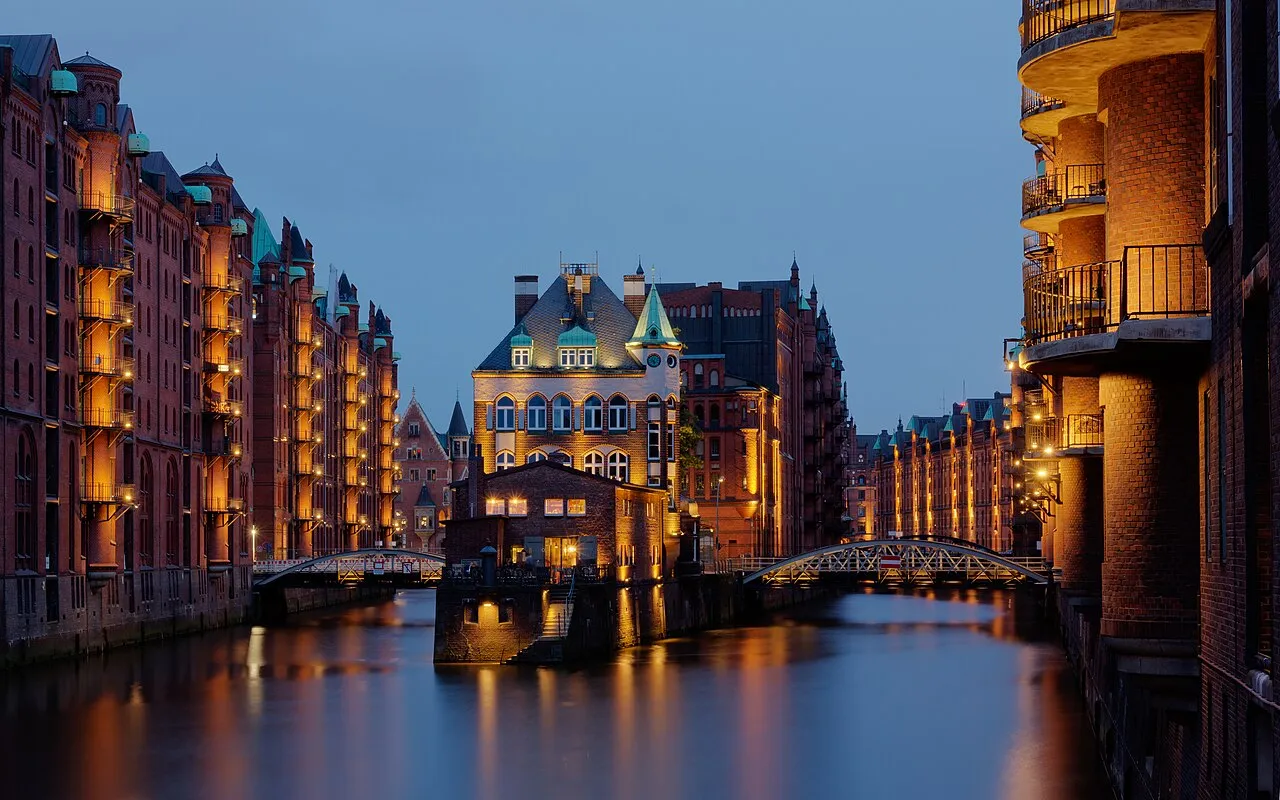
City · Hamburg
HamburgInvesting in Hamburg Real Estate: The Wealthy Port City of Northern Germany
Investing in Hamburg real estate is an investment in one of the most sought-after markets in Germany: in 2025 an existing apartment sold for an average of 5,761 EUR per sq m. The city is growing, wealthy and relies on a port, aviation and trade. Whoever looks at Hamburg is buying stability and long-term value retention, in a large city-state.
Video
Hamburg in one minute
Investing in Hamburg: the figures, what to check and common questions, in a short video. All details and sources are in the text below.
No narration, background music only. The video does not play by itself.
In brief
- 1,869,473 residents at the end of 2025, growth of 0.4% in one year (Statistikamt Nord).
- Existing apartment: 5,761 EUR per sq m. New apartment: 8,758 EUR per sq m (2025 transaction average).
- City of Hamburg rent index (Mietenspiegel) 2025: 9.94 EUR per sq m.
- Transfer tax 5.5% (as of November 2026). City-wide rent brake until the end of 2029.
- More than 120 thousand students in winter 2024/25.
Why here
Why do investors look at Hamburg?
Hamburg is the second largest city in Germany, and it is also a federal state in its own right. It keeps growing: in 2025, 91,309 people moved to it and 82,777 left, so the migration balance was positive by 8,532 people (Statistikamt Nord). Slow, consistent growth like this is exactly what an apartment owner wants to see: demand that does not depend on a single wave.
The price places Hamburg in the middle. It is about a third cheaper than Munich, and about 20% more expensive than Berlin (BIG 7 comparison, 2025). In new apartments the gap with Berlin is larger, 8,758 EUR per sq m against 6,891. For an investor this means that an existing apartment in a good district is usually the right entry point.
In Hamburg about 5.0 housing transactions per 1,000 residents were recorded in 2025. This is a market of long holding, where owners tend to keep a property for years, so it is worth planning the holding period in advance and comparing the price with transactions recorded in the area.
In numbers
Key figures: Hamburg in numbers
- Population1,869,473Statistikamt Nord, 31.12.2025
- Average transaction price, existing apartment5,761 EUR per sq mStuttgart Valuation Committee, BIG 7 comparison (2025)
- Average transaction price, new apartment8,758 EUR per sq mSame (2025)
- Rent in existing contracts (Mietenspiegel)9.94 EUR per sq m net coldRent index 2025, reference date 1.4.2025
- Asking rent on a new letting
- Transfer tax5.5%State table, as of November 2026
- Students121,397Hamburg Science Authority, winter 2024/25 (provisional)
Hamburg's rent index was built from about 47,450 surveyed apartments. In the 2025 version the city moved to calculating by median, so the comparison with the 2023 version (9.83 EUR) is approximate.
Rent in Hamburg: how do you calculate correctly?
When you compare a rent index of 9.94 EUR per sq m with an average transaction price of 5,761 EUR, you get a gross yield of about 2.1% per year by the city average. To understand the number you need to know the structure of the market. In Hamburg a large share of apartments belongs to municipal housing companies and cooperatives (Genossenschaften), where tenants pay less than in the open market, and this affects the average.
An apartment bought in the open market and let on a new contract can yield more than this average, within the rules: the Senate extended the rent brake to the whole city until the end of 2029, so in a new lease up to 10% above the local customary rent is allowed, under German tenancy law. The decision was published in November 2025, as reported by beck-aktuell.
The conclusion is that in Hamburg you calculate by the lease of the specific apartment, and not by the city average or by listings.
Want to check whether it suits you?
Book an intro callEconomy and employment: the port and what lies beyond it
The port is the historic heart of the economy. Shipping and logistics companies, including Hapag-Lloyd and the terminal operator HHLA, employ tens of thousands directly and indirectly. Beyond the port, Hamburg is one of the largest civil aviation centers in the world: Airbus assembles aircraft in Finkenwerder, and Lufthansa Technik is based in the city. Hamburg is also home to the Otto Group, Beiersdorf and large media houses such as Der Spiegel and Die Zeit.
This variety maintains broad demand for apartments. Workers in the port, aviation, trade and media, together with more than 120 thousand students, create a large and varied pool of tenants.
Where in the city
In which Hamburg districts do people invest?
| District | Character | Note for the investor |
|---|---|---|
| Eimsbüttel, Eppendorf, Winterhude | Sought-after Altbau, families and academics | High demand and stable tenants |
| Altona, Ottensen | Urban, young, close to the water | Good liquidity, many preservation areas (Erhaltungsverordnung) |
| Barmbek, Wandsbek | Down-to-earth residential, good transport | Lower price, broad demand |
| HafenCity | A new district on the water | New, modern construction, check the owners' association fees |
| Harburg, Wilhelmsburg | South of the river, renewal | Accessible entry price, municipal renewal projects |
| Blankenese, Othmarschen | Luxury, villas | Stability and long-term value retention |
Hamburg's preservation areas (Erhaltungsverordnung) are similar to Milieuschutz in Berlin: renovation, merging apartments or conversion require approval. Before buying in such a district, check what is permitted in the building.
What you buy
What types of property are common in Hamburg?
- Red-brick buildings from the early 20th century: typical of the inner districts and in demand. Check the insulation and the heating system. What to check in the certificate is covered in the energy certificate guide.
- Apartments in buildings from 1950–1970: the majority in the in-between districts. A lower price per sq m, and the association's renovation plan is especially important.
- New construction in HafenCity and in new projects: a modern standard. What the owners' association charge includes and what passes on to the tenant is explained in the Hausgeld guide.
Illustrative example
A numerical example: a 60 sq m apartment in Hamburg
To the yield calculatorAssumptions: average transaction price for an existing apartment (2025), no broker, rent according to the rent index. Conversion at 4 NIS per euro, for illustration only.
| Item | Amount |
|---|---|
| Price (60 × 5,761) | 345,660 EUR (about 1.38 million NIS) |
| Transfer tax 5.5% | 19,011 EUR |
| Notary and registration (market estimate of 1.5%–2%) | 5,185–6,913 EUR |
| Total before financing | about 369,900–371,600 EUR |
| Annual rent by the rent index (9.94 × 60 × 12) | 7,157 EUR |
This income covers about 1.9% of the total cost per year, before expenses and tax, by the city average. In a new lease in the open market the calculation is made on the actual rent. All the additional purchase costs are detailed in the closing costs guide.
Before you buy
What do you check before buying an apartment in Hamburg?
Several points come up in Hamburg transactions more than in other cities:
- Leasehold (Erbbaurecht). In some buildings, mainly in projects on municipal land, the apartment stands on leased land with annual ground rent. Check in the land register whether the land is owned or leased and until when, and coordinate the financing with the bank.
- Location relative to the water. Parts of the city are close to the Elbe. Check city maps and building insurance that includes natural hazards (Elementarschaden).
- Owners' association minutes. In the old brick buildings, check which decisions were made on facade insulation or on the heating system, and how they are budgeted.
- The lease. Calculate on what is written in the existing contract: level, tenure and the date of the last update.
- The comparison price. Compare the asking price with land values (Bodenrichtwerte) and with transactions recorded in the area.
Before you decide
Advantages and what to check in Hamburg
Advantages
- A population growing through migration
- A varied economy of port, aviation, trade and media
- A price a third lower than Munich, in an A-city with a deep market
- Transfer tax of 5.5%, lower than Berlin and NRW
- More than 120 thousand students
- Stability and long-term value retention
What to check
- The existing lease: level, tenure and last update
- The district: proximity to transport and employment hubs
- Land ownership or leasehold
- The preservation area rules and the rent brake
- Owners' association minutes and the renovation plan
- Price against land values and transactions in the area
Who is Hamburg real estate especially suited to?
Hamburg real estate suits an investor looking for a stable property in a growing A-city, long-term value retention and professional tenants. It suits those who bring significant equity and plan to hold for years, and who prefer the security of a large, varied city over a high current yield. Those comparing A-cities can look at real estate in Berlin. The principal differences between types of cities are explained in the guide to A, B and C cities and in big city versus small town. All the cities in one comparison are on the Germany real estate map.
Open properties in Hamburg
All available opportunities are gathered at open properties for investment.
Frequently asked questions
What people ask us About Hamburg
How much does an apartment in Hamburg cost?
The 2025 transaction average for an existing apartment was 5,761 EUR per sq m, and for a new apartment 8,758 EUR (BIG 7 comparison). In districts like Eppendorf or Blankenese the price is much higher, and in Harburg it is lower.
What is the transfer tax in Hamburg?
5.5% of the property price, as of November 2026. On an apartment of 350,000 EUR that comes to 19,250 EUR.
Is there a rent brake in Hamburg?
Yes. The Senate extended the rent brake ordinance to the whole city until the end of 2029. In a new lease, up to 10% above the local customary rent is usually allowed, with exceptions for new construction and comprehensive renovation.
How is the rental market in Hamburg structured?
Many apartments belong to municipal housing companies and cooperatives, where rent is lower than in the open market, and this affects the average of the rent index. An apartment in the open market is let on market terms, within the limits of the rent brake.
Can you buy an apartment in a cooperative (Genossenschaft) in Hamburg?
In a cooperative you do not buy an apartment, but shares that grant the right to live in it, so it is not an investment route. An investor buys an owned apartment (Eigentumswohnung), registered in their name in the land register.
Can an Israeli buy an apartment in Hamburg?
Yes. Germany has no restriction on a non-resident buying an apartment, and the process is the same as for a local buyer: a contract at a notary and registration in the land register. What is important to plan is the financing, taxation in both countries and management from a distance.
Sources
- Statistikamt Nord: release 108/2026, population and migration (31.12.2025)
- City of Hamburg: rent index 2025 (December 2025)
- City of Hamburg: number of students (winter 2024/25)
- German Ministry of Justice: tenancy law, the rent brake (in force 2026)
- beck-aktuell: extension of the rent brake in Hamburg to 2029 (November 2025)
- Stuttgart Valuation Committee, BIG 7 comparison: prices and transaction pace (2025)
This is not investment, tax or legal advice. All investment involves risk.

Intro call
Want to compare Hamburg with other cities?
We will go through a district, a lease and a price with you, and check whether Hamburg fits your goal.
In the photo: Munich and the Alps, Bavaria